

Progressions and regressions sound straightforward until you’re standing in front of twelve people with twelve different bodies, twelve different histories, and twelve different responses to the same cue.
This post breaks down how to make those decisions clearly, consistently, and without second-guessing yourself mid-class.
What to Change First
Most teachers reach for the most obvious variable, range of motion, when they want to make something harder or easier. That’s not always the right lever to pull first.
Range of Motion
Reducing range is often the most accessible regression for clients managing pain, stiffness, or limited mobility. Increasing range is a natural progression once control through the existing range is established. The keyword is control. More range without control isn’t a progression. It’s just more range.
Load
Load changes are most relevant on the Reformer, where spring resistance directly affects how much the body has to work. In mat work, load tends to come from limb position. A long arm or leg increases the demand on the working muscles. A shorter one reduces it. Understanding which direction you’re moving and why is what makes load modification intentional rather than incidental.
Complexity

Complexity refers to how many things a client has to coordinate at once. A single-leg movement is less complex than the same movement with an arm pattern layered on top. Breath timing, sequencing, and speed all add complexity. When a client is struggling, reducing complexity often resolves the issue faster than reducing range or load. This is where how common teaching mistakes show up in new Pilates instructors becomes relevant. Over-cueing complexity is one of the most common ones.
The Three-Level Options Model
Before you teach any exercise in a group class, it helps to have three versions ready: a foundation option, a standard option, and a challenge option. Not because everyone will need all three, but because knowing they exist changes how you teach.
Foundation
The foundation option supports clients who are new, managing a condition, or working through a movement pattern for the first time. It removes variables rather than adding them. The goal is to establish the pattern with confidence, not to limit the client permanently.
Standard
The standard option is what most of the room will work with most of the time. It assumes a baseline of movement awareness and physical capacity. It’s where the teaching lives for the majority of the class.
Challenge
The challenge option adds a variable, a wider range, more load, more complexity, or a combination. It’s for clients who are moving well through the standard version and are ready for more demand. The challenge option should still be teachable within a group setting. If it requires so much individual attention that it disrupts the class, it belongs in a studio session instead.
Research available through PubMed on exercise progression consistently supports the principle that systematic, graduated progression produces more durable outcomes than sporadic intensity increases.
How to Progress Without Rushing
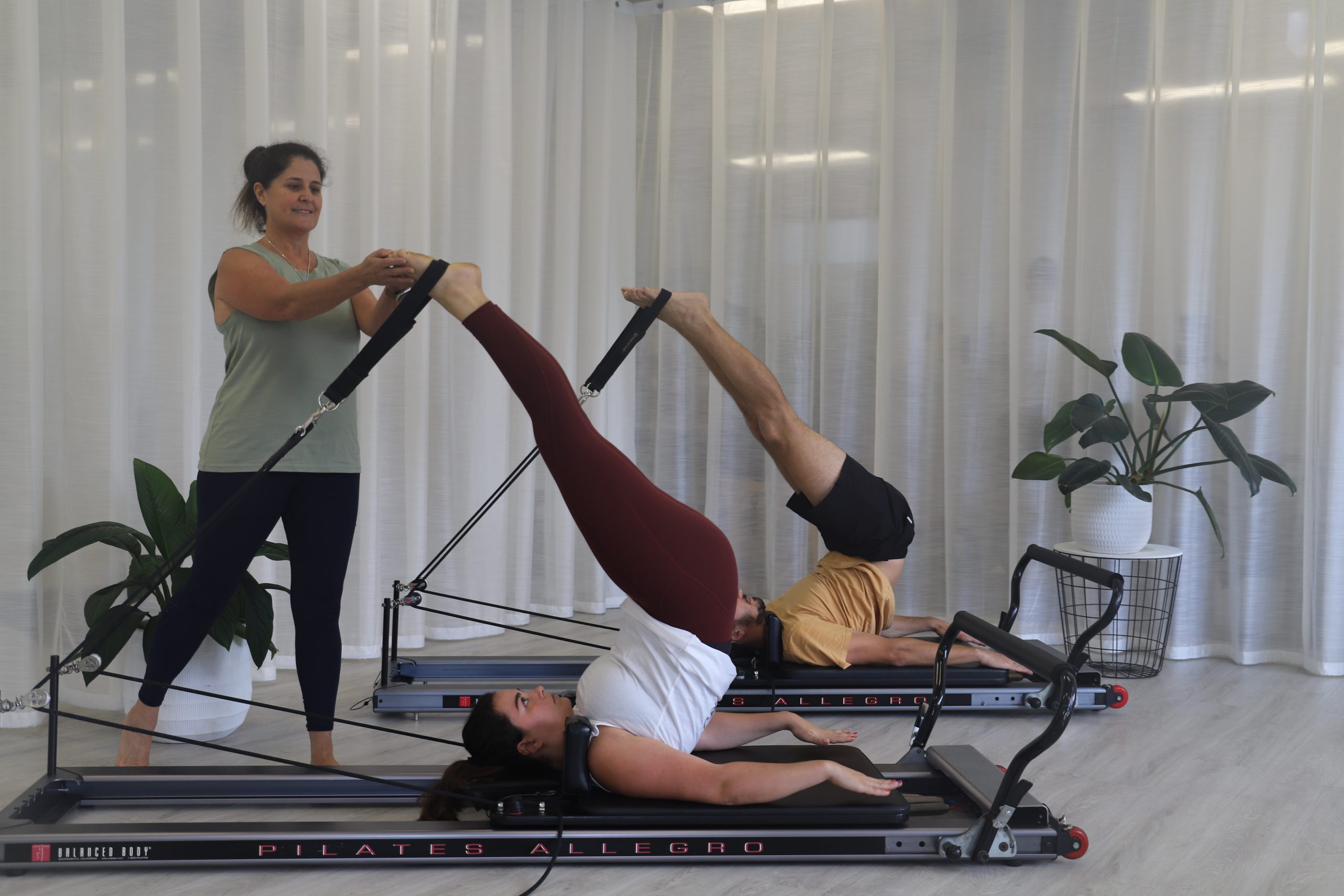
The pressure to progress clients can come from the client themselves, from a sense that the class needs to feel challenging, or from uncertainty about what else to offer. None of those is a good reason to move forward before someone is ready.
Look for Control, Not Completion
A client completing an exercise isn’t the same as a client controlling it. Watch for breath-holding, compensatory movements, facial tension, or loss of spinal position. These are signs that the current version still has work in it. Completion is the floor, not the ceiling.
Progress One Variable at a Time
If you increase range, load and complexity at the same time, you don’t know which change made the difference when something goes wrong. Progress one variable at a time. It’s slower. It’s also more informative and more sustainable for the client.
Use the Exhale as a Readiness Test
If a client can maintain their breath pattern through an exercise, including a controlled exhale on effort, they’re likely managing the demand appropriately. If the breath disappears, the demand is probably too high. This is a simple in-class check that doesn’t require stopping the session to assess.
The PMC open access database has a strong body of research on load management and readiness indicators that’s worth exploring if you want to go deeper into the evidence base.
What to Do With a Mixed-Ability Room
A mixed-ability class is the norm, not the exception. The teachers who handle it well aren’t offering a different session to each person. They’re designing a session that has enough flexibility built in from the start.
Design for the Middle, Modify at the Edges
Plan your session around the standard option. Know your foundation and challenge modifications before you walk in. That way, when someone needs a different version, you’re offering it from preparation, not improvisation.
Cue in Layers
Start with the movement. Then add a refinement cue for people who are moving well and want more detail. Then offer a modification for anyone who needs it. This keeps the class moving without singling anyone out and gives everyone something to work with at their level.
Use the Room’s Variation as a Teaching Tool
When three people in the room are doing three different versions of the same exercise well, that’s not a problem. That’s evidence that your programming is working. Name it occasionally. It normalises variation and helps newer clients understand that modification is a sign of good teaching, not a consolation prize. For more on how to make this feel genuinely inclusive rather than just logistically manageable, the Five Ways to Make Your Pilates Classes More Inclusive article is a useful companion to this one.
The WHO rehabilitation guidelines also highlight the importance of individualised load management across mixed populations, a principle that applies directly to group Pilates teaching.
Sample Progressions: Mat and Reformer
These aren’t prescriptive sequences. They’re examples of how the three-level model applies to specific exercises so you can see the thinking in practice.
Single Leg Stretch (Mat)
Foundation: both feet down, one knee drawing in at a time, hands on shins, no arm pattern. Standard: alternating legs with a straight leg extension, hands reaching toward the ankle and knee. Challenge: increased tempo, longer lever on the extended leg, breath pattern coordinated with the switch.
Hundred (Mat)
Foundation: tabletop legs, small arm pump, focus on breath pattern only. Standard: legs at 45 degrees, full arm pump, coordinated breath. Challenge: lower legs toward the floor while maintaining a neutral pelvis, increased breath volume.
Footwork (Reformer)
Foundation: higher spring resistance, smaller range of movement, focus on even loading through both feet. Standard: standard spring load, full range, attention to spinal position and breath. Challenge: single leg variation, reduced spring resistance, increased demand on stability and inner unit control.
Long Stretch (Reformer)
Foundation: knees down, focus on ribcage over pelvis alignment and shoulder position. Standard: full plank position, controlled push and pull through the full range. Challenge: reduced spring resistance, added rotation, or single arm variation.
FAQs
How do I know when a client is ready to progress?
Look for three things: consistent control through the current version, breath that stays organised throughout, and the ability to self-correct when you give a cue. If all three are present across multiple sessions, a progression is probably appropriate.
What if a client insists they want the harder version before they’re ready?
This is a teaching conversation, not a negotiation. You can acknowledge what they want and explain what you’re seeing. Something like: “I can see you’re keen to push further, and I want to get you there. What I’m noticing is that your breath disappears at the end of the movement, which tells me there’s still work to do here first. Let’s build that, and then we’ll move forward.” That’s honest, specific, and respects the client’s intelligence.
Is it ever appropriate to regress a client who has been doing the standard version for months?
Yes. A client returning from illness, managing a flare-up, coming back after a break, or working through a new condition may need to step back temporarily. Frame it as responsive programming, not a setback. “Given what you’ve told me today, let’s work here and build back from a solid base” lands very differently than implying they’ve gone backwards.
How do I manage progressions in a class where I can’t see everyone at once?
Design your sequences so clients spend enough time in each exercise to self-regulate before you move on. Cue clearly, then observe. Move around the room with intention rather than staying at the front. Know which clients need the most monitoring and position yourself where you can see them without neglecting the rest of the room.
Should I tell the class which option is the foundation and which is the challenge?
Sometimes. Naming the options gives clients agency and helps them develop movement awareness over time. Just avoid language that implies a hierarchy of worth. “Here’s a version with more support” rather than “here’s the easy version.” The language shapes how clients understand their own progress.
It Is Not About Knowing More Exercises
The teachers who manage mixed ability rooms well aren’t working from a bigger exercise library. They’re working from a clearer framework. They know what to change, when to change it, and why. That reasoning is teachable, and it’s at the centre of what the Polestar Pilates Comprehensive Diploma covers.
The Polestar Pilates Comprehensive Diploma (11292NAT) is delivered as a combination of face-to-face and online learning. For 30 years, we’ve been helping instructors build the kind of understanding that holds up in the room, with everybody, every session.
Not sure where to start? Get in touch, and we’ll help you find the right pathway.